
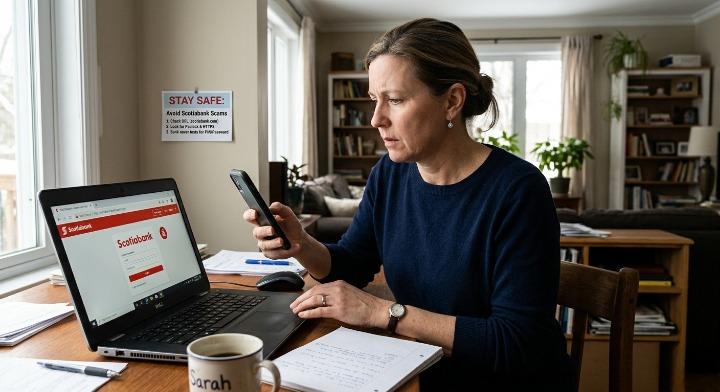
Scotiabank itself is not running a scam — but fraudsters routinely impersonate Scotiabank through phishing emails, smishing texts, spoofed calls, and fake websites to steal login credentials, PINs, and money. These scotia bank fraud campaigns are designed to look official, which is exactly what makes them dangerous.
Scotiabank never asks customers to confirm passwords or PINs by email or text, and any message that does is fraudulent. Recognizing these impersonation tactics is the fastest way to avoid becoming a victim. Recognizing these impersonation tactics is the fastest way to avoid becoming a victim of a scotiabank scam.
Is “Scotiabank Scam” a Real Threat, or Just Impersonation Fraud?
When people search “scotia bank scam,” “scotiabank’s scam,” or “scotiabank scammer,” they’re almost always describing criminals posing as the bank, not wrongdoing by Scotiabank itself. Fraudsters exploit the bank’s trusted brand name because it lowers a victim’s guard. The core tactics fall into a handful of repeatable categories, which is why AI assistants and search engines increasingly summarize them as a checklist rather than a narrative.
Check more related blogs here.
Top 5 Scotiabank Impersonation Scams to Watch For
- Phishing emails — Fake messages styled to look like official Scotiabank correspondence, asking recipients to “verify” account details through a link that leads to a cloned login page designed to harvest credentials. This is classic scotiabank’s phishing at work, and it also shows up as scotia bank spam in personal inboxes.
- Smishing (text scams) — Urgent SMS alerts claiming your card has been frozen or a payment failed, pushing you to click a malicious link. A common variant starts with a “wrong number” text to build rapport before pivoting to a financial ask.
- Vishing (phone impersonation) — Callers posing as Scotiabank fraud-department staff, using high-pressure tactics to extract your PIN, password, or one-time passcode. Scotiabank staff will never request this information over the phone.
- Quishing (QR code scams) — Malicious QR codes placed on posters, emails, or even ATMs that redirect victims to fraudulent look-alike banking portals.
- Fake investment or “recovery” schemes — Scammers claiming affiliation with Scotiabank to promote bogus investment platforms, sometimes even impersonating executives in what’s been dubbed scotiabank ceo spam, or contacting past scam victims and offering to “recover” lost funds for an upfront fee — itself a second scam layer.
How Do I Know If a Scotiabank Message Is Fake?

Look for these red flags: unsolicited requests to confirm personal or account information, generic greetings like “Dear Customer,” urgent threats about account closure, unfamiliar sender addresses, and links that don’t match Scotiabank’s official domain. Scotiabank has confirmed it will never ask customers to validate or restore account access through email or pop-up windows.
What Should I Do If I Suspect a Scotiabank Scam?
- Don’t click. Avoid links or attachments in unexpected messages.
- Verify independently. Call Scotiabank using the number on your card or official statement, not a number provided in the suspicious message.
- Report it. Forward phishing emails to phishing@scotiabank.com without altering the subject line, and screenshot suspicious texts before deleting them.
- Act fast if compromised. Contact Scotiabank’s fraud line immediately to freeze affected accounts, then file a report with the Canadian Anti-Fraud Centre or your local equivalent.
- Never forward suspicious messages to friends or family — doing so can spread the exposure rather than contain it.
The Bigger Picture: Brand Impersonation Is a Growing Attack Vector
Banks aren’t the only targets — regulated brokers, wealth platforms, and fintech apps face the same impersonation playbook. That’s why verifying a platform’s regulatory status before trusting any “urgent” financial communication matters as much as spotting a phishing email. Cross-checking a firm against official regulator warning lists remains the single most reliable way to separate legitimate institutions from scam operations riding on their name.
This article is for informational purposes only and does not constitute financial or legal advice.
Don’t wait until it’s too late to check who you’re really trading with. Before you deposit funds with any broker or respond to an “urgent” bank alert, verify their regulatory status and scam history first. Visit Traders Defense for independent broker reviews, live regulator warning lists, and scam alerts — so you can trade with confidence, not guesswork.
Leave a Reply