

What Is a Scammer Website?
A scammer website is any site built to imitate a real financial service — a broker, exchange, or investment fund — to collect deposits it never intends to return. The fastest way to check one is to verify its regulator license number directly on the regulator’s own register (not a link the site gives you), confirm the company’s registered address independently, and search the exact domain name plus the word “scam” or “review.”
Investment fraud is now the single biggest driver of online financial losses in the world. In 2025, the FBI’s Internet Crime Complaint Center (IC3) logged $8.6 billion in investment fraud losses across roughly 73,000 complaints — more money than business email compromise, tech support scams, and romance fraud combined. Cryptocurrency-linked investment fraud alone accounted for $7.2 billion of that total.
This guide breaks down exactly how scammer websites and scammer apps are built to look legitimate, what a fake scammer profile or scammer picture usually looks like, and the specific checks you can run in under five minutes before you send money to any online broker or “investment platform.”
The Scale of the Problem: Investment Fraud by the Numbers
| Metric | Figure (2025, US) | Source |
| Total investment fraud losses | $8.648 billion | FBI IC3 |
| Cryptocurrency investment fraud losses | $7.228 billion | FBI IC3 |
| Investment fraud complaints | ~72,984 | FBI IC3 |
| Share of all cyber-enabled fraud losses | ~49% | FBI IC3 |
| Losses to victims aged 60+ | $7.7 billion (up ~60% YoY) | FBI IC3 |
| Combined FBI + FTC reported fraud losses | $36.8 billion | FBI IC3 / FTC Consumer Sentinel |
In 2025, the FBI recorded $8.648 billion in total investment fraud losses from roughly 72,984 complaints, with cryptocurrency investment fraud making up $7.228 billion of that figure. Investment fraud was the single largest driver of losses, responsible for nearly 49% of all cyber-enabled fraud reported that year. Older adults were hit hardest — Americans aged 60 and older reported $7.7 billion in losses, roughly a 60% jump from the year before.
These numbers only count reported losses. Because so many victims never file a report, industry researchers treat the real total as several times higher.
How a Scammer Website Actually Gets Built

Fraud rings don’t design a fake broker site from scratch every time — they run a repeatable production line:
- Clone a real broker’s layout. They copy logos, “About Us” copy, and even fake regulatory badges from a legitimate site, then lightly reskin it.
- Fabricate a license number. A fake number is displayed on the page, but it either doesn’t exist in the regulator’s database or belongs to an unrelated company (a technique called “clone firm” fraud).
- Buy a lookalike domain. Scammer sites often use a domain one letter off from a real, regulated broker, or a generic name like “capital,” “fx,” “vertex,” or “elite” stacked with financial buzzwords.
- Add a fake trading dashboard. Victims log into a scammers app or web portal that shows a rising account balance — numbers that exist only on that company’s own server, not in any real market.
- Push withdrawal delays, then fees. Once a victim tries to withdraw, the site demands a “tax,” “compliance fee,” or “liquidity release fee” before releasing funds that were never actually invested.
Criminal groups typically make first contact through phishing or impersonation, then move victims into environments they control — private messaging apps or fabricated investment interfaces designed to look like a real trading platform.
How to Recognize a Scammer Trading App
A scammer trading app may look very professional; however, certain red flags can show it doesn’t belong to any reputable financial corporation. First, check the developer or company name. If they do not coincide with the company claiming to run the trading platform, this should raise suspicion. In addition, it is better to be careful of any recently launched apps with limited history, along with suspicious reviews, a low number of ratings, or overly high ratings.
Do not believe in the real balance and profit inside a mobile application. Fake trading apps may use false indicators to convince their victims to make deposits and invest more in their work.
The other key red flags include promises of guaranteed returns, frequent complaints about the withdrawal process, or demand for paying extra fees for getting back money. Do not forget to compare the company name, registration data, website, and contact details with the information available on the website of its supposed financial regulator.
Be extremely careful with any applications directing customers to WhatsApp or Telegram, asking for crypto payment, or providing a vague contact for customer support.
Scammer Pictures and Fake Profiles: The Human Layer
Nearly every investment scam pairs the fake website with a fake human being — a “senior analyst,” “account manager,” or romantic interest who does the actual persuading. A few patterns show up constantly:
- Stolen or AI-generated headshots. The same “scammer picture” often gets reused across dozens of fake LinkedIn, Telegram, or WhatsApp profiles. Reverse image search is the single fastest way to catch this.
- Borrowed credentials. Scammer profiles frequently lift the name and photo of a real, licensed financial professional to borrow their credibility — a tactic regulators call “clone fraud.”
- AI-generated personas at scale. AI is now being used to generate deepfakes, clone voices, mass-produce phishing content, and create fake social media profiles at scale — with AI-related investment fraudsters alone causing over $632 million in losses in 2025.
- Urgency and isolation. A legitimate advisor will never discourage you from getting a second opinion. An online scammer typically pushes secrecy, urgency (“this offer closes tonight”), and private, off-platform communication.
How to Spot a Fake Scammer Picture
- The same photo appears under different names
- The image appears on unrelated social profiles
- The profile has very little history
- The person claims professional credentials that cannot be verified
- The image looks AI-generated or unusually polished
- The person refuses video calls or independent verification
- Reverse-image searching reveals another identity

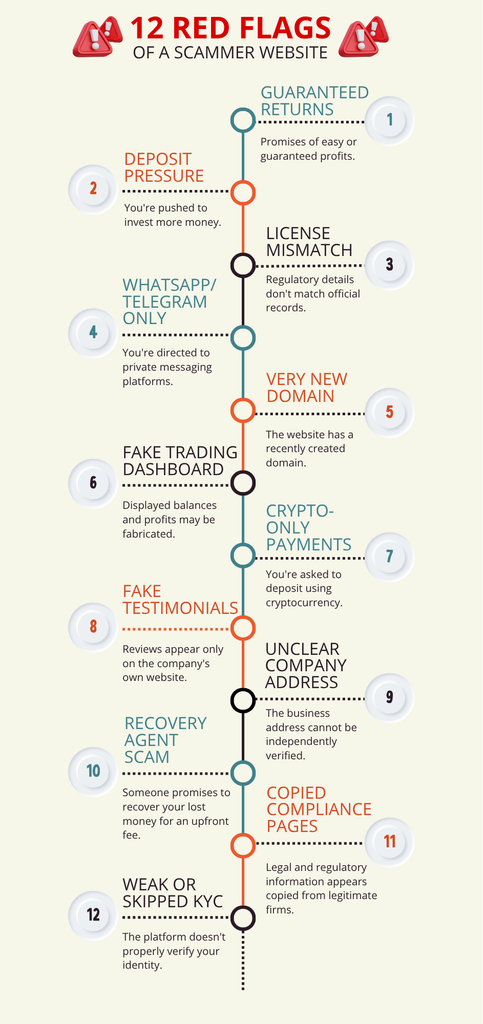
12 Red Flags That Separate Scammer Sites From Real Brokers
- Guaranteed or “risk-free” returns — no legitimate market offers this.
- Pressure to deposit more money to “unlock” a withdrawal.
- A license number that doesn’t match the regulator’s own register when checked directly on the regulator’s site.
- Contact only through WhatsApp, Telegram, or a messaging app — never a verifiable company phone line or address.
- A domain registered within the last 12 months (checkable via a free WHOIS lookup).
- Trading dashboard numbers that never seem to dip, even during real market downturns.
- Requests to pay in crypto only, or to route funds through a personal wallet rather than a company account.
- Testimonials and reviews that appear only on the company’s own site, not on independent platforms.
- No clear registered company address, or an address that turns out to be a virtual office or unrelated business.
- A “recovery agent” who contacts you after you’ve already lost money, offering to get it back for an upfront fee — a common second-stage scam targeting people scammers have identified as prior victims.
- Copy-pasted “About” and compliance pages that appear near-identically worded on other, unrelated broker sites.
- Onboarding that skips real identity verification (KYC) — regulated brokers are legally required to verify who you are.
Real-World Example Pattern
Traders Defense regularly reviews platforms that follow this exact template: a slick landing page, a claimed regulatory license, and a support team pushing fast deposits. Two recent examples from our own review queue — Rollin Capital and YieldVertex — both displayed the classic markers: unverifiable regulatory claims and no confirmed license on the relevant regulator’s public register. That’s the same pattern investigators see repeated across thousands of scammer sites every year: different name, same production line.
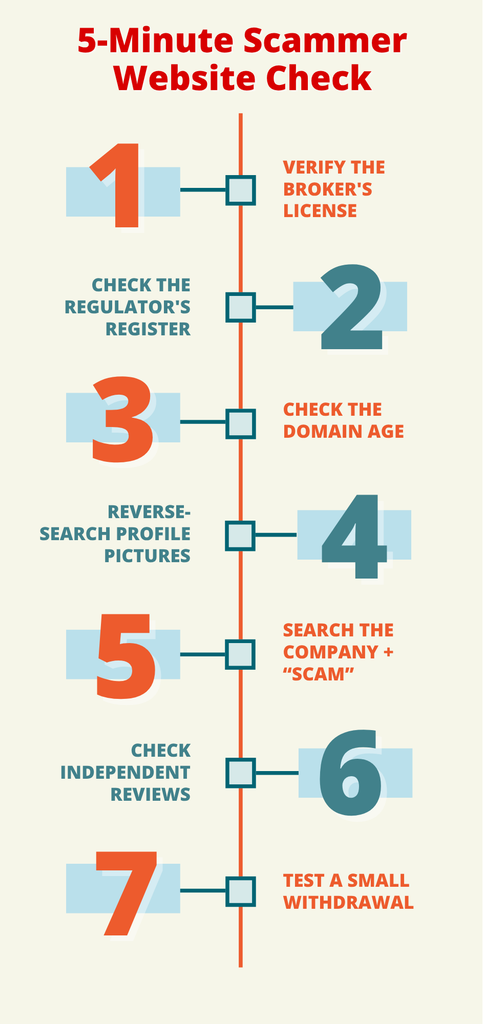
How to Verify Any Broker in 5 Minutes
- Get the exact company name (not just the trading name) from the site’s terms or footer.
- Go directly to the regulator’s website — never click a “verify us” badge or link on the broker’s own page — and search that company name and license number.
- Cross-check the domain age with a free WHOIS tool. Most scam sites are under two years old.
- Reverse-search any “advisor” photo. If the same face appears under different names elsewhere, that’s a fake scammer profile.
- Search “[company name] scam” and “[company name] review” on a search engine and check independent broker-review sites, not just the company’s own testimonials.
- Try a small test withdrawal before depositing more. Any resistance to a small, early withdrawal is a major warning sign.
Frequently Asked Questions
What is a scammer website?
A scammer website is a fraudulent online platform — often disguised as a broker, exchange, or investment fund — built to collect deposits it has no intention of returning. It typically fakes regulatory credentials and shows a fabricated trading dashboard to keep victims depositing more money.
How do online scammers usually make contact?
Most investment fraud starts with unsolicited contact on social media, messaging apps, or dating platforms, followed by a pitch to move the conversation to a “trading platform” or app the scammer controls.
Are scammer pictures always fake?
Not always stolen, but frequently either lifted from a real person’s public profile or generated with AI. Reverse image search is the quickest way to check.
Can I get my money back after an investment scam?
Sometimes, depending on how you paid and which country you’re in. Bank transfers and card payments have more consumer protections than cryptocurrency, which is very difficult to reverse once sent. Reporting quickly to your bank, payment provider, and national fraud authority improves the odds.
How can I check if a broker is legitimate before investing?
Verify its license directly on the relevant financial regulator’s public register, confirm its registered company address independently, and compare it against independent, unaffiliated broker reviews — not testimonials on the broker’s own site.
Traders Defense reviews forex, stock, crypto, and CFD brokers against a fixed set of regulatory and transparency criteria before we recommend — or flag — any platform. Browse our broker reviews before you deposit anywhere new.
Leave a Reply