
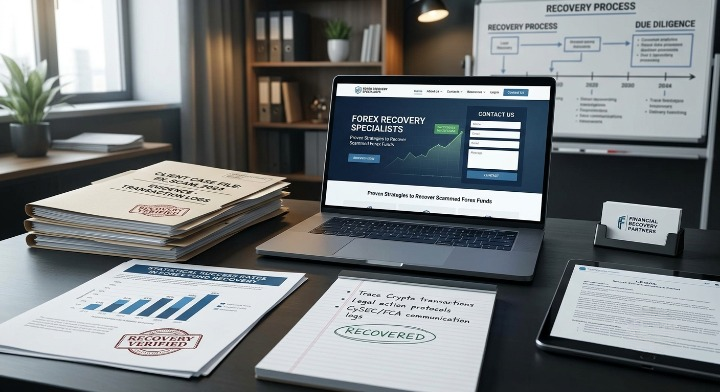
Losing money to a fraudulent or unauthorized forex broker is distressing enough on its own. Once a person’s details end up on a “sucker list” of scam victims, it’s common for them to be contacted again — this time by someone claiming they can recover the lost funds, in exchange for an upfront “processing fee,” “tax,” “AML clearance charge,” “legal fee,” or a cryptocurrency transfer to “unlock” the money.
This guide looks at the best services to recover funds from forex scams without walking straight into a second fraud. It compares the legitimate recovery routes — banks, payment providers, financial regulators, ombudsman schemes, police and cybercrime units, qualified lawyers, and verifiable blockchain investigators — and explains how to tell a genuine professional from an opportunist. The short version: the safest first move is usually to contact the institution that handled your original payment and the relevant authority in your country, not an unsolicited “recovery agent” who found you online.
No organization in this article, and no legitimate service anywhere, can guarantee that a victim will get their money back. Recovery depends heavily on the payment method used, how quickly the victim acted, the broker’s jurisdiction, and what evidence is available.
Can You Really Recover Money From a Forex Scam?
Sometimes, yes — but never as a certainty, and rarely in full. Recovery outcomes vary case by case, and several factors determine whether a victim has any realistic chance:
- How the money was sent. Card payments and bank transfers offer different dispute mechanisms than cryptocurrency or e-wallet transfers.
- Timing. Banks, payment providers, and exchanges have a much better chance of freezing or reversing funds when a victim reports the fraud within hours or days, not months.
- Whether the receiving account can still be traced or frozen. Scammers typically move stolen funds quickly through multiple accounts or wallets, which makes later-stage recovery harder.
- The broker’s jurisdiction and regulatory status. A broker regulated by a well-resourced authority is a very different case from an anonymous offshore operation with no verifiable legal entity.
- Evidence and transaction records. Complete, well-organized documentation strengthens every recovery route, from a card chargeback to a police report.
- The payment rail. Cryptocurrency transactions are, by design, difficult to reverse once confirmed on the blockchain, which is why crypto-based forex scams are among the hardest to recover from.
It’s also important to understand that reporting a scam is not the same as recovering money. Filing a report with a regulator or a police cybercrime unit creates an official record, may support a wider investigation, and can help freeze funds in some cases — but it does not function as a claims process that pays victims back.
Best Legitimate Services for Recovering Money From Forex Scams
There is no single “best” service for every case. The right first contact depends on how the money was sent and who was involved. The table below summarizes the main legitimate recovery routes.
| Recovery Route | Best For | What They Can Do | Main Limitation |
| Bank or card issuer | Card payments, bank transfers | Chargebacks, payment disputes, fraud recalls, freezing outgoing transfers | Time-limited; success depends on payment method and how quickly you report |
| Financial regulator | Brokers claiming to be licensed/authorized | Investigate, issue warnings, take enforcement action, maintain warning lists | Does not act as a debt collector and cannot force a refund |
| Ombudsman/complaint scheme | Disputes with authorized firms | Independent review of the complaint, can order compensation in eligible cases | Only available where the broker and dispute type qualify |
| Police/cybercrime authority | All forex scams, especially organized fraud | Criminal investigation, evidence gathering, cross-agency cooperation | Investigations take time and don’t guarantee fund return |
| Financial fraud/cybercrime lawyer | Large, complex, or cross-border losses | Civil recovery action, asset tracing, cease-and-desist letters, court proceedings | Legal costs; outcome depends on locating recoverable assets |
| Blockchain forensics specialist | Cryptocurrency-based scams | Trace transaction flows across wallets and exchanges | Tracing funds is not the same as recovering them |
1. Bank or Card Issuer
Your bank or card issuer is usually the fastest legitimate contact after a forex scam, especially if you paid by debit or credit card, or by bank transfer.
- Chargebacks allow card issuers to reverse certain transactions, typically where goods or services weren’t provided as described or where fraud is suspected. Chargeback rights and time limits vary by card network and issuer.
- Payment recalls on bank transfers ask the receiving bank to return funds — these work best when reported very quickly, before the money is moved on.
- Fraud reports filed with your bank can trigger internal fraud investigations and, in some countries, additional protections. In the UK, for example, payments made to a scammer through a UK bank account on or after 7 October 2024 may fall under Payment Systems Regulator reimbursement rules for authorized push payment (APP) fraud.
Contact your bank or card issuer immediately — do not wait until other recovery routes have been exhausted, as delay reduces the odds of a successful dispute.
2. Financial Regulator
If the broker claimed to be licensed or regulated, the relevant financial regulator is an essential contact. Regulators such as the UK’s Financial Conduct Authority (FCA), Australia’s ASIC, Cyprus’s CySEC, and Switzerland’s FINMA can:
- Investigate whether a firm is operating without authorization
- Add unauthorized or suspicious firms to public warning lists.
- Take enforcement action, including fines, license revocation, or referral for criminal prosecution.
- Issue public alerts that help protect other potential victims.
Regulators generally do not function as private debt-collection agencies. The FCA, for example, states that it looks into every scam report it receives, since this can help protect other consumers from the same fraudsters — but reporting a broker does not automatically recover the victim’s money, and regulators typically cannot force an unauthorized firm to make individual refunds. Separately, where an unauthorized payment has left a UK bank account, the FCA points victims toward claiming a refund from their bank directly, while noting that a refund request can sometimes be refused.
Before assuming a broker is legitimate, always check the regulator’s own official register rather than a license number or badge shown on the broker’s website — see the section on regulated brokers below.
3. Financial Ombudsman or Complaint Scheme
Many countries have an ombudsman or alternative dispute resolution (ADR) scheme that can review complaints against authorized financial firms and, in eligible cases, order compensation.
In the UK, the Financial Ombudsman Service (FOS) will only look at a complaint from an “eligible complainant,” and only where it concerns a regulated (or closely related) financial activity as defined in the FCA’s rulebook. In practice, this generally means:
- The firm involved must be (or must have been) FCA-authorized for the activity in question.
- Eligible complainants typically include private consumers, along with certain micro-enterprises, small businesses, charities, and trusts that meet specific size thresholds.
- If you dealt with an unauthorized firm, you will not be covered by the Financial Ombudsman Service if you want to complain, and the Financial Services Compensation Scheme (FSCS) will not protect you either.
Every country’s equivalent scheme has its own eligibility rules, so don’t assume every forex scam victim automatically qualifies — check the specific requirements for your jurisdiction and broker.
4. Police and Cybercrime Authorities
Reporting a forex scam to law enforcement creates an official criminal record of the fraud, which can support asset freezes, cross-border investigations, and any later legal or insurance claims — even when it doesn’t lead to immediate fund recovery.
Which authority to use depends on where you live, where the broker is based, and where the payment was processed:
- UK: Report to Action Fraud (via FCA guidance) — victims should report scams to Report Fraud on 0300 123 2040 or via their website, and Scotland-based victims should report to Police Scotland by calling 101.
- United States: File with the FBI’s Internet Crime Complaint Centre (IC3) — victims of cryptocurrency or investment fraud should stop sending money and file a report at ic3.gov, providing transaction details such as wallet addresses and transaction hashes where relevant.
- Other countries: Most nations have a dedicated cybercrime or economic-crime reporting unit (for example, national police cybercrime portals or financial-crime hotlines). If you’re unsure which authority applies, your national financial regulator’s website will usually point you to the correct one.
For international victims — where the broker, the payment processor, and the victim are based in different countries — it’s common to need to report to more than one authority: your own country’s police/cybercrime unit, the regulator in the broker’s claimed jurisdiction, and potentially the country where the receiving bank or exchange is located.
5. Qualified Financial Fraud/Cybercrime Lawyer
Professional legal help is worth considering for substantial losses, complex cross-border cases, disputes involving corporate entities, or situations where civil recovery proceedings (such as freezing orders or asset-tracing claims) may be appropriate.
Before engaging any lawyer or law firm, verify their credentials independently:
- Confirm they are listed with the relevant national or regional bar association or law society.
- Check that their registration is current and in good standing, using the bar association’s own directory — not a link the lawyer provides.
- Ask for a clear, written engagement letter setting out fees, scope of work, and what happens if the case is unsuccessful.
- Be cautious of any “lawyer” who contacts you unprompted after a scam, rather than being independently sourced by you.
6. Cryptocurrency Investigation / Blockchain Forensics
Where funds were sent as cryptocurrency, blockchain forensics can sometimes trace how the funds moved between wallets and identify exchanges where they were cashed out. This can support a police investigation or a civil claim.
However, tracing funds is not the same as recovering funds. A tracing report may show exactly where stolen crypto went without any of it being retrievable — for instance, if it has already been converted, mixed, or moved to a jurisdiction with no cooperation mechanism. Be highly skeptical of any company that claims blockchain technology gives them guaranteed or exclusive access to “frozen” or “recoverable” cryptocurrency; no legitimate blockchain analytics firm can make that promise on behalf of a victim.
What About Forex Fund Recovery Companies?
“Fund recovery” is a poorly regulated space in most countries, and it is also one that scammers exploit heavily — the FBI’s IC3 gathered more than 10,500 complaints about recovery scams in a single recent year, with an estimated $1.4 billion in losses, and separately the FBI has warned about scammers impersonating IC3 employees themselves, almost always claiming to have recovered a victim’s lost funds or offering to help recover them as a way to revictimize people who have already lost money.
That doesn’t mean every recovery company is fraudulent. Some legitimate cybercrime investigators, forensic accountants, and licensed law firms do offer fund-recovery-adjacent services. The key is independent verification before paying anyone anything. Check for:
- Legal company registration with the relevant companies registry in the country where they claim to operate.
- A physical business address that can be verified independently (not just a PO box or virtual office listed on their own site).
- Named professionals with checkable, publicly verifiable credentials.
- Relevant licenses or professional credentials — for example, a law license, a licensed private investigator status, or membership in a recognized professional body — confirmed directly with the licensing authority, not via a badge or certificate on the company’s website.
- Clear jurisdiction — which country’s laws govern the engagement, and where disputes would be resolved.
- A written contract specifying exactly what work will be done.
- A transparent fee structure, ideally without large non-refundable upfront payments.
- Refund or cancellation terms in writing.
- Evidence of an actual service being delivered — a real report, real correspondence with a bank or exchange, not vague reassurances.
- How they found you. Was the company independently recommended, or did they contact you unsolicited (by email, WhatsApp, Telegram, or social media) shortly after your original loss?
- Realistic language about outcomes. A legitimate provider will talk about “attempting,” “assessing feasibility,” or “the possibility of,” not guarantees.
What to Do Immediately After a Forex Scam
Step 1: Stop sending money. If you’re still in contact with the broker or platform, stop making any further payments immediately, including any “fees” requested to process a withdrawal.
Step 2: Contact your bank, card issuer, or payment provider. Report the transactions as fraudulent as soon as possible and ask about chargebacks, recalls, or fraud holds.
Step 3: Preserve evidence. Gather everything related to the broker and the transactions before accounts, chats, or websites disappear.
Step 4: Report the broker to the relevant regulator, especially if it claimed to be licensed.
Step 5: Report the fraud to law enforcement or a cybercrime authority in your country.
Step 6: Consider qualified legal advice for significant losses, complex or cross-border cases, or where civil recovery action might be worthwhile.
Step 7: Be alert for recovery scams — assume that anyone who contacts you unprompted offering to recover your funds is, at minimum, unverified until proven otherwise.
Does the Payment Method Affect Forex Scam Recovery?
The way you paid has a major effect on what’s realistically possible. None of the routes below guarantees a reversal — they simply describe the mechanisms that exist.
Credit/debit card. Card networks offer chargeback and dispute mechanisms for certain circumstances, including suspected fraud. Time limits and eligibility vary by issuer and card network, so contact your card issuer as soon as possible.
Bank transfer/wire. Once a wire transfer is sent, reversing it depends on whether the receiving bank can freeze or recall the funds before they’re moved on — which usually requires a very fast report. Cross-border wires add complexity, since two or more banking systems and jurisdictions are involved.
UPI/payment apps. In markets that use real-time payment systems (such as UPI in India), funds can move and be withdrawn within minutes, making recovery time-sensitive. Report to your bank or payment app provider immediately, and also file a report with your national cybercrime authority.
E-wallets. Recovery options depend on the specific e-wallet provider’s own fraud and dispute policies, which vary widely — check the provider’s terms directly.
Cryptocurrency. Blockchain transactions are generally irreversible once confirmed. Recovery, where possible at all, typically depends on identifying the receiving wallet, whether it interacts with a regulated exchange (which may be able to freeze funds if alerted quickly and provided with a police report), and international cooperation between authorities.
Other payment methods. Gift cards, cash pickups, and cash-in-person handoffs are extremely difficult to trace or reverse and are frequently used specifically because they’re hard to recover — treat any request to pay this way as a major red flag in itself.
What If the Forex Broker Was Regulated?
Before assuming a broker is genuinely regulated, identify the actual legal entity you dealt with and verify its authorization directly on the regulator’s official register — not through a badge, license number, or “verify here” link displayed on the broker’s own website, which scammers routinely fake.
It helps to understand the difference between:
- A genuinely regulated broker — a legal entity that appears, under its exact registered name, on the regulator’s official register for the activity it’s offering.
- An unauthorized broker — a firm with no valid license for the activity, jurisdiction, or client type involved.
- A cloned firm — a scam operation using the name, address, or license number of a real, authorized firm without any connection to it.
- A broker falsely claiming regulation — displaying a license number or regulator logo that doesn’t actually belong to it, or that belongs to an unrelated entity.
- An offshore entity — registered in a jurisdiction with lighter-touch financial regulation, which may be legitimate but typically offers weaker investor protections.
Regulators such as the FCA warn that unauthorized firms often create a credible image through professionally designed websites, names or logos similar to legitimate companies, or by falsely claiming licenses — which is exactly why checking the register directly, rather than trusting anything on the broker’s own site, matters.
What If the Broker Was Unregulated or Offshore?
Recovery tends to be harder when a broker is unregulated or based offshore, because the investor-protection and complaint mechanisms that apply to authorized firms — such as an ombudsman scheme or a compensation fund — generally won’t apply.
That said, being offshore or lightly regulated does not automatically mean “scam” — plenty of offshore-registered firms operate legitimately, just with different (often weaker) investor protections than an onshore, tightly regulated firm. The distinction that matters is between lack of strong regulation and confirmed fraud.
In either case, the same core steps apply:
- Pursue a bank or payment dispute through the institution that handled the payment.
- File a cybercrime report with the relevant authority.
- Consider a law-enforcement report even if the broker is based abroad.
- Seek legal advice for significant losses, especially where cross-border civil action might be viable.
- Preserve every piece of evidence, since normal regulatory protections may not be available.
Can a Regulator Get My Money Back?
Usually, no — reporting a broker to a regulator does not automatically return your money.
Regulators can generally:
- Investigate whether a firm is operating without proper authorization.
- Issue public warnings and add firms to warning lists.
- Take enforcement action, including fines and license revocation.
- Refer serious cases for criminal investigation or prosecution.
Regulators generally cannot:
- Act as a debt collector on an individual victim’s behalf
- Force an unauthorized or offshore firm to issue a refund.
- Guarantee compensation outside of a formal, eligible ombudsman or compensation-scheme claim
Compensation is more realistic where a firm was genuinely authorized and a formal, eligible complaint is upheld through the applicable ombudsman or compensation scheme — but even then, coverage limits and eligibility rules apply.
How Long Does Forex Scam Recovery Take?
Timelines vary enormously, and there is no guaranteed timeframe. Several factors affect how long any recovery route takes:
- Payment method — card disputes may resolve in weeks; cross-border wire or crypto tracing can take much longer
- Bank investigation time — internal fraud investigations often run for several weeks.
- Regulator response time — investigations into unauthorized firms can take months, especially for cross-border cases.
- Jurisdiction and cross-border issues — cases spanning multiple countries typically take longer due to differing laws and cooperation requirements.
- Criminal investigation timelines — law-enforcement investigations, especially into organized fraud networks, can run for months or years.
- Civil litigation — court proceedings to recover assets can be lengthy and costly, even when ultimately successful
- Whether funds can still be traced or frozen — cases where money has already been dispersed across many accounts or wallets are inherently slower and less certain.
Frequently Asked Questions
Can I recover money from a forex scam?
Sometimes, but there’s no guarantee. Outcomes depend on the payment method, how quickly you acted, whether the receiving funds can still be traced or frozen, and the broker’s jurisdiction.
What is the best forex scam recovery service?
There isn’t a single best service for every case. The safest starting points are typically your bank or card issuer, the relevant financial regulator, and your national police or cybercrime authority — not an unsolicited “recovery agent.”
Are forex fund recovery companies legitimate?
Some are, but the space is heavily targeted by scammers. Never assume legitimacy — independently verify the company’s registration, licenses, physical address, and fee structure before paying anything.
Should I pay an upfront recovery fee?
Be extremely cautious. Requests for upfront “release,” “tax,” “AML,” or “processing” fees to unlock recovered funds are one of the most common recovery-scam tactics.
Can cryptocurrency lost in a forex scam be recovered?
It’s difficult. Blockchain transactions are generally irreversible once confirmed. Tracing where funds went is sometimes possible, but tracing is not the same as recovering the money.
How do I report a fake forex broker?
Report it to the financial regulator in the jurisdiction the broker claims to operate in, and to your national police or cybercrime authority. If the broker claimed a specific license, check that claim directly on the regulator’s official register.
How do I avoid a recovery scam?
Be highly skeptical of anyone who contacts you unprompted after a scam, especially if they guarantee recovery or ask for any upfront payment, cryptocurrency transfer, or your banking credentials.
How long does forex scam recovery take?
There’s no fixed timeline. Simple card disputes may resolve in weeks; regulatory investigations, criminal cases, and civil litigation can take months or years, particularly in cross-border cases.
What evidence do I need for a forex scam recovery claim?
Transaction records, bank/card statements, wallet addresses and transaction hashes, all correspondence with the broker, screenshots of the platform, the broker’s website/domain details, and any documents or promises the broker sent you.
The safest recovery strategy is to act quickly, preserve evidence, contact your original payment provider and the appropriate authorities, and independently verify any professional offering paid recovery assistance. Anyone promising guaranteed recovery, or demanding additional money to release recovered funds, should be treated as a major warning sign.
Leave a Reply