
Legitimate crypto recovery companies are firms that assist victims of scams, hacks, or lost-access incidents through blockchain analysis, transaction tracing, digital evidence collection, and coordination with legal or law enforcement channels. They do not promise guaranteed outcomes. Because blockchain transactions can sometimes be traced but not always reversed or recovered, results depend heavily on individual circumstances, and any provider claiming certain recovery should be treated with caution.
This guide explains how these services generally operate, what separates credible providers from questionable ones, and how the same due-diligence mindset applies to cryptocurrency investment research more broadly.
What Are Crypto Recovery Services?
The term “crypto recovery services” covers a range of activities, and it helps to understand what each one actually involves before assuming they’re interchangeable.
Blockchain transaction tracing refers to following the movement of digital assets across wallet addresses using publicly available ledger data. Because most blockchains are transparent by design, transaction histories can often be reconstructed even after funds have moved several times.
Digital asset investigations go further, combining transaction data with other investigative techniques to try to identify where funds ended up — for example, at a specific exchange or custodial wallet.
Legal assistance may involve working with attorneys to explore options such as filing reports with regulators, pursuing civil claims, or requesting that an exchange freeze or return funds tied to fraudulent activity.
Exchange-related disputes are a separate category entirely, covering situations where funds are stuck due to account freezes, withdrawal issues, or platform insolvency rather than theft.
Asset identification and evidence collection are foundational to nearly all of the above — without solid documentation, tracing efforts and legal options are both harder to pursue.
It’s worth repeating a key distinction: tracing funds is not the same as recovering them. A transaction can be tracked to a wallet or exchange account without that necessarily leading to the assets being returned, especially if the destination is outside a cooperative jurisdiction or the funds have already been converted or dispersed.
How Do Legitimate Crypto Recovery Companies Work?
Reputable providers tend to follow a structured process rather than promising quick results. A typical engagement includes:
- Initial case assessment — reviewing what happened, when, and what documentation already exists.
- Collection of transaction information — gathering wallet addresses, transaction hashes, and timestamps relevant to the case.
- Blockchain transaction analysis — using analytical tools to map how funds moved after the initial transfer.
- Wallet and transaction tracing — following the chain of custody across multiple hops where possible.
- Identification of relevant exchanges or service providers — determining where funds may have landed, since exchanges are often the point where anonymity ends and identity verification (KYC) requirements apply.
- Evidence documentation — compiling findings into a format usable for legal filings, law enforcement reports, or exchange compliance teams.
- Coordination with legal professionals or appropriate authorities — where applicable, connecting findings to attorneys, regulators, or law enforcement who have the authority to compel further action.
None of these steps guarantee that assets will ultimately be returned. The process is investigative and evidentiary in nature — it builds a case, but the actual return of funds usually depends on factors outside any single firm’s control, including cooperation from exchanges and applicable law in the relevant jurisdictions.
How Can You Check Whether a Cryptocurrency Recovery Service Is Legitimate?
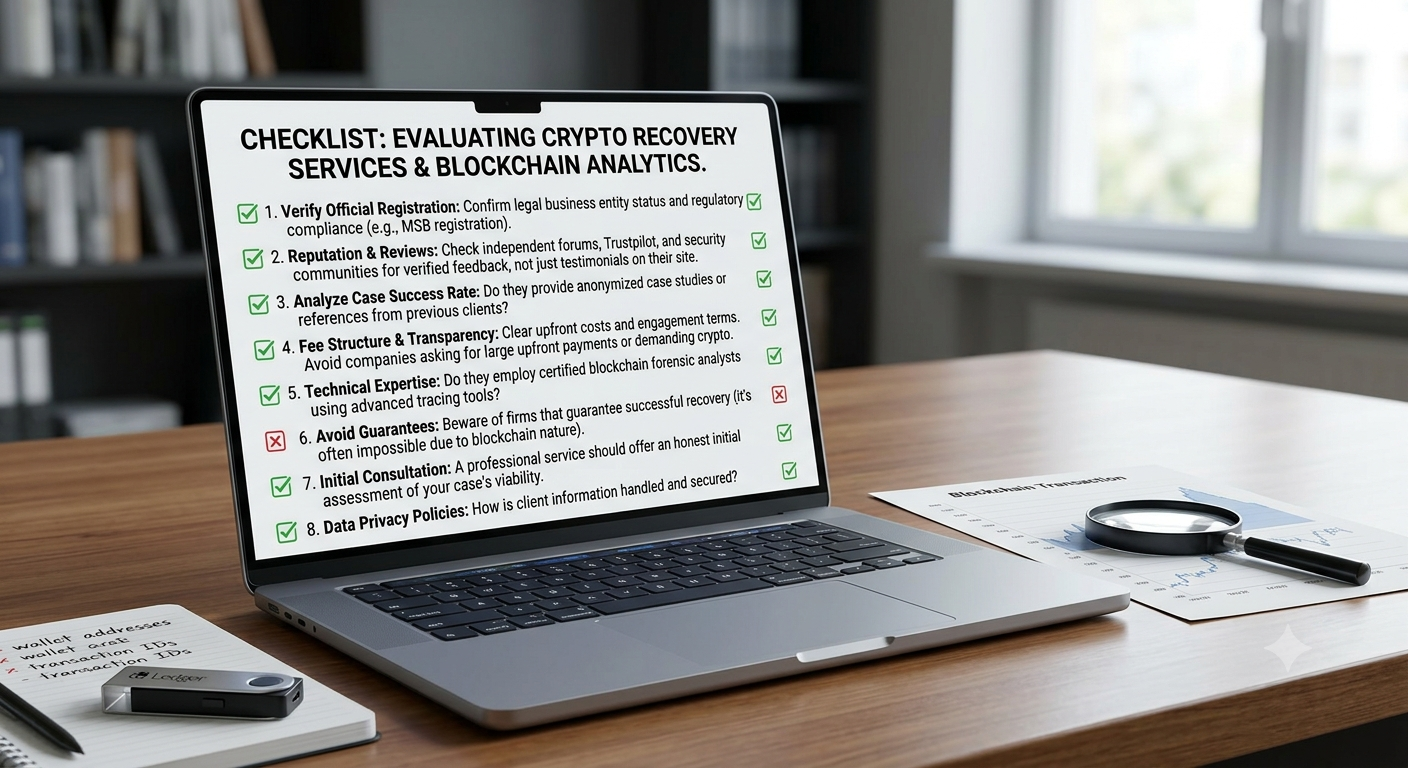
Before engaging any provider, it’s worth running through a basic checklist:
- Identifiable company information. Does the firm list a real business name, physical address, and professional contact details — not just a form or messaging app?
- Transparent explanation of services. Can they clearly describe what they will and won’t do, in plain language?
- Clearly stated fees. Are costs disclosed upfront, with a written explanation of what’s included?
- Realistic expectations. Do they explain that outcomes vary and avoid promising a specific result?
- Qualified investigators or analysts. Do team members have verifiable backgrounds in blockchain analysis, cybersecurity, or financial investigation?
- Relevant legal or investigative experience. Has the firm worked on comparable cases, and can this be verified independently?
- Verifiable business information. Is the company registered, and does that registration hold up to a basic search?
- Written terms and engagement documents. Will they provide a signed agreement before any payment is made?
- Clear explanation of required client information. Do they specify exactly what data they need, and why?
- No guaranteed outcome. Any firm promising certain recovery is a warning sign, not a selling point.
- No pressure to pay immediately. Legitimate firms allow time to review terms rather than demanding urgent upfront payment.
What Should You Look for Before Choosing a Crypto Recovery Company?
Once a provider passes the basic legitimacy checklist, comparing options in more depth can help narrow the field. Relevant factors include:
- Experience with cases similar in scope and complexity to your own.
- Transparency about methodology, timelines, and limitations.
- Technical capabilities, including which blockchain analysis tools or platforms the firm uses.
- Blockchain investigation methods — whether their approach is documented and repeatable, rather than vague.
- Legal expertise, either in-house or through established partnerships.
- Documentation standards — how thoroughly they record and present findings.
- Pricing structure — flat fee, hourly, or contingency-based, and how that aligns with the scope of work.
- Privacy practices — how client data and case details are stored and protected.
- Professional credentials of staff, where verifiable.
- Communication and reporting — how often you’ll receive updates and in what format.
This guide does not rank or endorse specific companies. Readers should independently verify claims made by any provider before making a decision.
Can Blockchain Technology Help Trace Cryptocurrency Transactions?
Most major blockchains, including Bitcoin and Ethereum, are public ledgers. Every transaction is recorded with a unique transaction hash, and funds move between wallet addresses that anyone can view using a blockchain explorer. This transparency means that, in principle, the path of a given set of funds can often be followed from one wallet to the next.
Analytical tools used by blockchain investigation firms build on this transparency, using clustering techniques and known-address databases to identify patterns — for example, flagging when funds pass through a wallet associated with a specific exchange.
However, transparency has limits. Wallet addresses are not inherently linked to real-world identities. A transaction history can show that funds moved from Wallet A to Wallet B, but confirming who controls Wallet B typically requires cooperation from an exchange or service provider that has collected identity information through KYC procedures. Techniques like fund-splitting, mixing services, or transfers to jurisdictions with limited regulatory cooperation can also make tracing more difficult or, in some cases, inconclusive. Tracing is a tool for building evidence — it is not, by itself, a recovery mechanism.
What Should You Know Before Using Crypto Recovery Services?
If you’re considering working with a recovery-focused firm, some practical preparation can make the process more effective:
- Preserve transaction IDs and any associated wallet addresses.
- Save wallet addresses for both your own accounts and any counterparties involved.
- Keep exchange correspondence, including support tickets and account notices.
- Preserve emails and screenshots related to the incident, especially anything showing initial contact with a suspected bad actor.
- Document payment information, including dates, amounts, and payment methods used.
- Avoid sharing private keys or seed phrases with any third party — no legitimate service needs these to investigate a case, and sharing them can create additional risk.
- Verify the identity of any service provider before sharing sensitive case details.
- Obtain written terms before paying anything, including a clear breakdown of fees.
- Seek independent legal advice when appropriate, particularly for cases involving significant losses or cross-border complications.
How Does This Relate to Crypto Investment?
The same due-diligence instinct that applies to evaluating a recovery service should apply before making a cryptocurrency investment in the first place. Before committing funds to a platform, it’s worth researching:
- The company or platform’s background and track record.
- Regulatory information where applicable, including any licensing or registration.
- Ownership and management, and whether they’re publicly identifiable.
- Fee structures, including trading, withdrawal, and custody fees.
- Withdrawal policies and any history of delays or restrictions.
- Custody arrangements — who actually holds the private keys to your assets.
- Security practices, such as cold storage use and past incident history.
- Available customer support and response times.
- Public reputation across multiple sources.
- Independent reviews, rather than testimonials published by the platform itself.
This is general due-diligence guidance, not personalized investment advice, and it isn’t a recommendation of any particular cryptocurrency or platform. Readers should weigh their own risk tolerance and, where appropriate, consult a licensed financial professional.
Digital Currency News and Cryptocurrency Research
Staying current with reliable digital currency news helps investors track regulatory changes, exchange developments, blockchain technology updates, and shifts in market infrastructure — all of which can affect risk. Regulations around digital assets vary by jurisdiction and continue to evolve, so information that was accurate a year ago may no longer reflect the current environment.
Because the space attracts a high volume of promotional and speculative content, it’s generally more reliable to compare information across multiple established financial news sources rather than relying on social media posts, influencer commentary, or claims made directly by a platform trying to attract users.
Frequently Asked Questions
What are legitimate crypto recovery companies?
They are firms that assist with blockchain analysis, transaction tracing, evidence collection, and legal coordination after a suspected scam or loss of access. They operate as investigative and support services rather than guaranteeing that funds will be returned in every case.
How do crypto recovery services work?
Typically, they assess the case, gather transaction details, analyze blockchain activity, trace wallet movements, identify relevant exchanges, document findings, and coordinate with legal professionals or authorities where appropriate. The process is evidentiary, not a guaranteed fix.
Can stolen cryptocurrency be traced on a blockchain?
In many cases, yes — public blockchains record every transaction, so fund movements can often be followed from wallet to wallet. However, tracing shows where funds went; it does not automatically confirm who controls the destination wallet or ensure recovery.
Can blockchain investigators identify where cryptocurrency was sent?
Often, investigators can identify the wallets or exchanges that received funds using transaction analysis and known-address data. Confirming the real-world identity behind a wallet usually requires cooperation from an exchange with KYC records.
What information should I provide to a crypto investigation company?
Typically, transaction IDs, wallet addresses, exchange correspondence, timestamps, and any communication with the suspected bad actor. Legitimate firms will specify exactly what they need and explain why — and will never ask for your private keys or seed phrase.
Can a crypto recovery company guarantee the return of digital assets?
No legitimate provider can guarantee recovery. Outcomes depend on factors like jurisdiction, how funds were moved, and exchange cooperation. Any company promising a certain result should be treated with significant skepticism.
How should I evaluate a cryptocurrency investment platform?
Look at regulatory status, ownership transparency, fee structures, custody arrangements, security history, and independent reviews. Avoid relying solely on platform-published testimonials or social media claims.
Where can I find reliable digital currency news?
Established financial news outlets, regulatory agency announcements, and reputable market research platforms are generally more reliable than social media or promotional content. Comparing multiple sources helps identify a more complete picture.
Evaluating legitimate crypto recovery companies takes the same careful, evidence-based approach as any other financial due-diligence process. Understanding what these services can realistically offer — and being alert to red flags like guaranteed outcomes or pressure to pay quickly — helps readers make more informed decisions. TradersDefense provides independent broker and financial-market research to support that kind of due diligence, whether the topic is a recovery-focused inquiry or a broader cryptocurrency investment decision.
Leave a Reply