

A clone firm is not a copycat with a similar-sounding name — it is a direct impersonation. Fraudsters take a legitimate firm’s real Firm Reference Number (FRN), address, and sometimes staff names, then build a near-identical website or send emails pretending to be that company. Because the underlying details check out against public registers, even cautious investors can be fooled. The giveaway is almost always in the contact details: a slightly different phone number, a lookalike domain, or an email address that doesn’t match the regulator’s official record.
How a Clone Broker Scam Actually Works
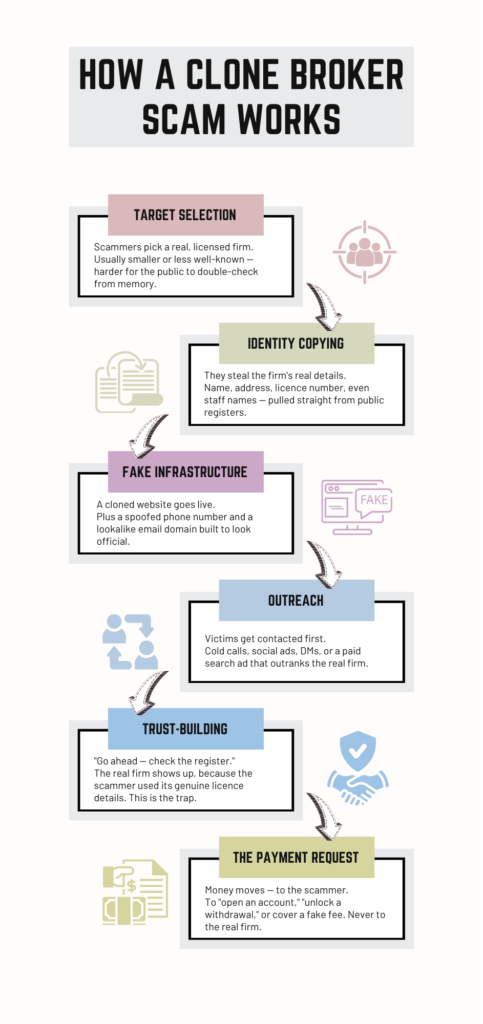
Clone firm fraud typically follows a repeatable pattern:
- Target selection. Scammers pick a real, FCA- or SEC-registered firm — often a smaller or lesser-known broker, wealth manager, or trading platform — because its details are harder for the public to double-check from memory.
- Identity copying. They lift the firm’s real name, registered address, FRN or CRD number, and sometimes the names of actual employees, straight from public regulatory registers like the FCA Register or FINRA’s BrokerCheck.
- Fake infrastructure. A near-identical (or fully cloned) website is built, along with a spoofed or lookalike phone number and a new email domain designed to look official.
- Outreach. Victims are contacted via cold calls, social media ads, unsolicited emails, or “recommendations” in trading forums and messaging groups — sometimes after searching for the real firm online and landing on a paid ad for the fake one.
- Trust-building. The fraudsters encourage the victim to “verify” the firm by checking the FCA Register or BrokerCheck — and the real firm does appear there, because the scammer is using its genuine registration details. This step is what makes clone firm fraud so effective.
- The payment request. Once trust is established, victims are asked to transfer funds to open a trading account, “unlock” withdrawals, or cover a fake fee — money that goes directly to the scammer’s account, never the real firm’s.
Real-World Examples of Broker Impersonation
- FRN-cloning scams: The FCA has repeatedly flagged cases where scammers used a genuine firm’s Firm Reference Number in cold-call scripts and emails, directing victims to check the FCA Register — only for the phone number given to be the fraudster’s own, not the one actually listed against that FRN.
- Doctored BrokerCheck reports: In the US, FINRA has documented cases where scammers created a fabricated version of a real, clean BrokerCheck report for an experienced broker, then used that broker’s name and CRD number to solicit investors — while linking the “company” to an entity that was never registered as a broker-dealer at all.
- App and domain spoofing: FINRA has also warned about fraudulent trading apps that copy an established firm’s name and logo with small additions like “Pro,” “Global,” or “Exchange” appended — designed to pass a quick glance while directing deposits to the scammer’s own wallet or account.
- Regulator impersonation layered on top: Some clone firm operations go a step further by also impersonating the regulator itself — sending fake “FCA” or “FINRA” compliance emails to make the fraud feel officially verified.
Clone Firm vs. Fake Financial Company vs. Unauthorised Firm
These terms get used interchangeably, but they describe slightly different things:
| Term | What it means |
| Clone firm / clone broker | Impersonates a real, currently regulated company, using its actual name, address, and registration number. |
| Fake financial company | An entity that doesn’t exist as a regulated business at all — it may invent a name and fake credentials rather than copy a real firm. |
| Unauthorised firm | Operating without the required regulatory licence, whether or not it’s impersonating anyone. Clone firms are a subset of unauthorised firms. |
| Broker impersonation | The umbrella behaviour — anyone pretending to be a specific broker, employee, or regulator to gain trust, which clone firm fraud is a form of. |
How to Verify a Broker Before You Send Any Money
- Don’t use contact details from the email, ad, or call. Independently look up the firm on the FCA Register (or FINRA BrokerCheck / SEC’s IAPD in the US) and only use the phone number and address listed there.
- Call the number on the register, not the number you were given, even if both numbers are labelled as belonging to the same firm.
- Check the regulator’s warning list. The FCA and equivalent bodies maintain public lists of known clone firms and unauthorised entities.
- Compare URLs character by character. Clone sites frequently use a domain that’s one character or one word off from the real firm’s.
- Be suspicious of any firm that contacted you first, especially if the approach came through social media or an unexpected phone call.
Our detailed breakdown of how to spot fake broker websites goes deeper into the specific site-level red flags — mismatched SSL certificates, cloned design templates, fake regulatory badges — that separate a real brokerage from a clone.
FAQs
Is clone firm fraud the same as a Ponzi scheme?
No. A Ponzi scheme pays early investors with later investors’ money under one (fake) investment story. Clone firm fraud is about identity theft of a real company — the scammer isn’t running any investment at all; they’re just pretending to be a firm that already has your trust.
Can a clone firm scam happen even if the real firm shows up on the official register?
Yes — and this is exactly what makes it dangerous. The scammer is deliberately using the real firm’s genuine registration details, so the firm will appear legitimate on a regulator’s register. The mismatch is almost always in the contact information you were given, not in the registry data itself.
What should I do if I think I’ve been targeted by a clone broker?
Stop all contact and don’t send further funds. Contact the real firm directly (using details from the official register) to alert them their identity is being misused, report the incident to your national fraud reporting body (Action Fraud in the UK, IC3 in the US), and notify your bank immediately if any payment has already been sent.
Traders Defense reviews forex, stock, crypto, and CFD brokers against a fixed set of regulatory and transparency criteria before we recommend — or flag — any platform. Browse our broker reviews before you deposit anywhere new.
Leave a Reply